
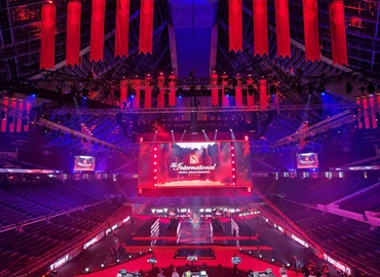
The 2022 Defense of the Ancients 2 (DOTA 2) eSports live world championship tournament held recently at the Singapore Indoor Stadium utilized d&b audiotechnik Soundscape technology to deliver immersive audio experiences to the in-person audience, emulating what the contest would sound like if they were wearing headphones or viewing at home.
The event is hosted by game developer Valve and is considered one of eSports’ biggest events, now in its 11th iteration. Jason Waggoner, owner of post production and live events agency Aural Fixation, has served as sound designer and department lead since 2018, consistently deploying d&b components in support of game sounds, announcer commentary and video playback in the arena as well as supporting live entertainment elements when called for. However, the 2022 interation marks the first time the audience was provided with an immersive audio experience.
“Soundscape gave the audience not only a better overall experience but a more homogenous one to what they’re used to,” Waggoner says. “This audience is used to watching at home on Twitch and YouTube, probably on headphones, and so we needed to deliver something more akin to that experience but at the same time had all the excitement of a live show.”
As part of d&b’s ArrayCalc, Waggoner employed d&b’s Soundscape Simulation software, a visualization tool designed to model a Soundscape system’s real and perceived acoustical performance within a space. The En-Scene simulation tool allows users to evaluate how the spatialization created with a Soundscape system will be experienced, which helps in optimizing a system;s design early in a production’s planning phase.
“The way Waggoner distributed the game sounds in Soundscape gave them a deeper and wider image than a traditional distribution, especially juxtaposed against our very forward “mono” vocal channel which was evenly distributed (also thanks to Soundscape) across all sources,” says Ian Davidson, front of house engineer at the tournament. “The result was a subtle but very effective immersive experience.”
The sound team also complemented Soundscape with d&b V series and ArrayProcessing. One of the challenges of the event is keeping as much audio as possible off the stage itself, with Waggoner noting that the pattern control and cardioid nature of the V series proving an important factor in the system’s success.
Additionally, the team used ArrayProcessing, an optional software function within the d&b ArrayCalc simulation software, that’s oufitted with an optimization algorithm to determine tailored filters helping control the behavior of the loudspeaker arrays (arranged in a left-center-right configuration) to deliver coverage to the 12,000-seat stadium.
“Being able to use ArrayProcessing is pretty crucial because of the even coverage that you get and the more consistent frequency response across the audience area,” Waggoner explains. “But it’s also very effective for something else unique to eSports: the play-by-play commentary is in the arena, not in a booth like they would be for a traditional sports broadcast. Using the cancellation functions within ArrayProcessing helps prevent as much extraneous audio as possible from echoing into the commentators’ headsets. That’s critical for broadcast.”
“This production is really about rewarding fans for their loyalty with this unique immersive sound experience,” he concludes. “Every year there’s a lot of focus and a lot of energy put into the live production and trying to find ways to create an arena setup that is maybe a little bit beyond just a normal sports event.”


