
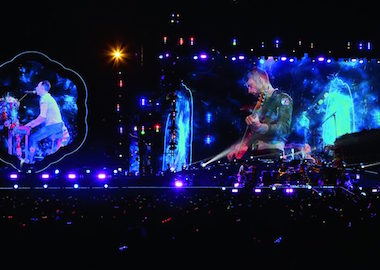
The latest
outing for Coldplay has just arrived in the US; a mix of arena and stadium
shows. After just six venues the production is already receiving accolades for
the quality of presentation, not least the audio.
“Through
Europe Wigwam supplied the system, but we took two audio techs from New York
based Firehouse, who provides the system over here,” explained system designer
Tony Smith. “Having Alex Fedrizzi and Brett Taylor from Firehouse out in Europe
has proved very positive in the transition phase to the US tour; we came here,
lost four Wigwam guys, gained four from Firehouse, and the tour just keeps on
rolling. We didn’t have to waste any time or energy getting everyone on board
with understanding what we are trying to achieve.”
That last
statement is telling. Both companies provide systems based on d&b’s
J-Series utilizing ArrayProcessing, a combination of system, design and
software that has achieved some notable results already. “We opened at the MetLife
Stadium,” explained Smith, “and the venue management told us afterwards that
our concert was the first in their history to receive no complaints about sound
whatsoever.”
There are
of course two elements at work here. Dan Green, who has been the band’s front
of house engineer since they first appeared on the public horizon, has a well
established reputation for a great live mix. But system design and
implementation has a significant role to play in ensuring every seat gets to
hear Green’s luxurious mix.
“The design
is all J-Series components,” continued Smith. “Left and right J mains, flown
J-SUBs, J side hangs, and 270 degree J rear hangs. We have a sub array of
J-SUBs and J-INFRAs across the front of the stage; then four towers of J for
delays down field. It has worked well for us in Europe; in the larger stadiums
there we generally had an overhanging roof so we flew a further ring delay of
d&b V-Series from the canopies above the nosebleeds. That option is not
available in the US; the stadia we play are all without roof canopies. At most
stadia here in the US the throw distance may be a bit shorter but the height
can be the same or higher on the sides in some venues. At MetLife in New Jersey
where we started, the resultant effect was having to drive the ArrayProcessing
software more than we have ever needed to in Europe, and squeezing as much out
of the system as possible. We could not get the same result as we would have
liked with a ring system, but I was more than happy with what the system was doing
and the benefit ArrayProcessing was bringing to the system.”
“MetLife
was a classic example of how those differences in stadium design between the US
and Europe manifest themselves. There was a section where we simply couldn’t
get the overlap between side and rear hangs (270 degrees), due to reaching the
maximum frame angle. When it came time to walk the venue, listening to the
lower bowl I thought ‘hmm, maybe I could swing that hang around a little for
the lower bleacher side sections’ (this was the lack of overlap section). But
we didn’t. We considered not just the overlap, but how that relatively small
adjustment would affect the upper bowl, and the whole room. ArrayProcessing was
really working hard in those areas to re-apportion sound energy where it was
needed most, so it was a balancing act and listening to the whole picture
before jumping to change things immediately.”
“When my
system tech Jack Murphy came back to measure after we had refined the timing
and applied the absolute minimum system EQ, we found the difference between
sound levels front of stage, and in this particularly awkward area, was about
-5dB, with the rest of the upper bowl nosebleed seats at about -3dB. It was the
right call to leave it alone. Being able to achieve that is a credit to d&b
and the ArrayProcessing software.”


