
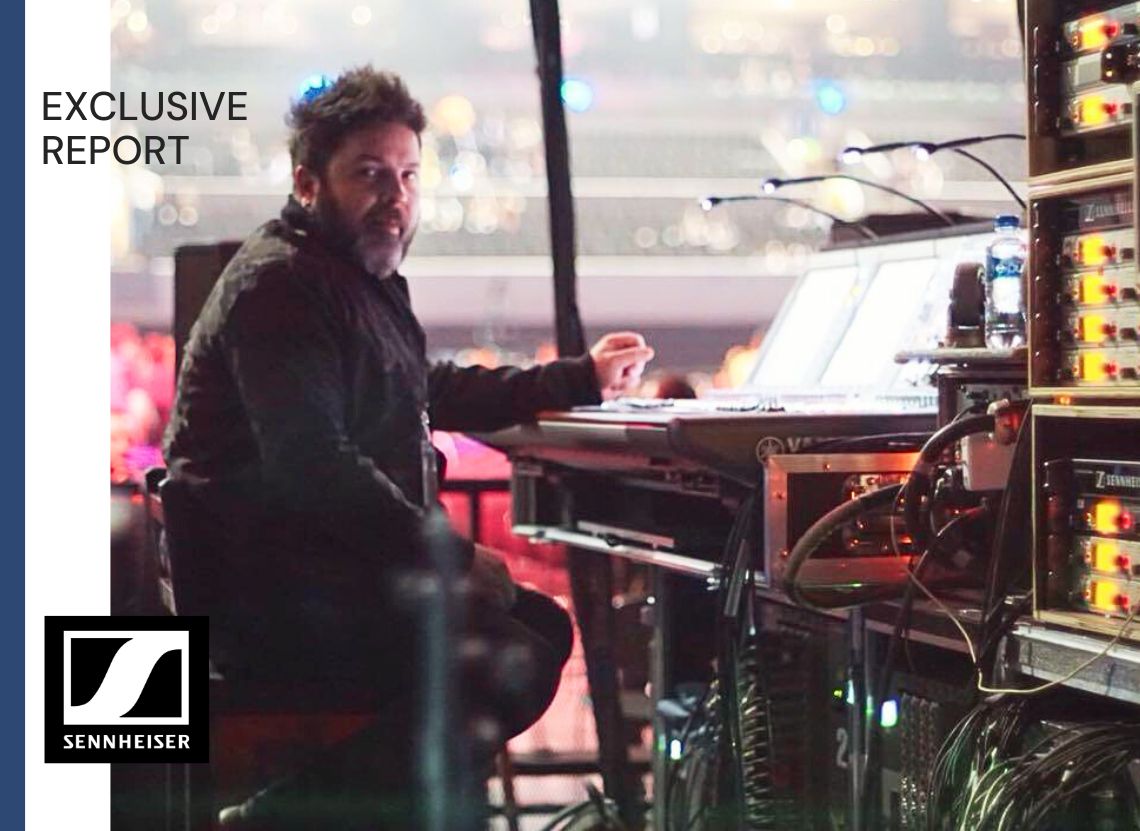
With a career marked by sensitivity and precision, Héctor ‘Chango’ Álvarez has solidified his place in the live audio scene. His connection with Sennheiser permeates every stage, reflecting a technical and emotional affinity that enhances every mix.
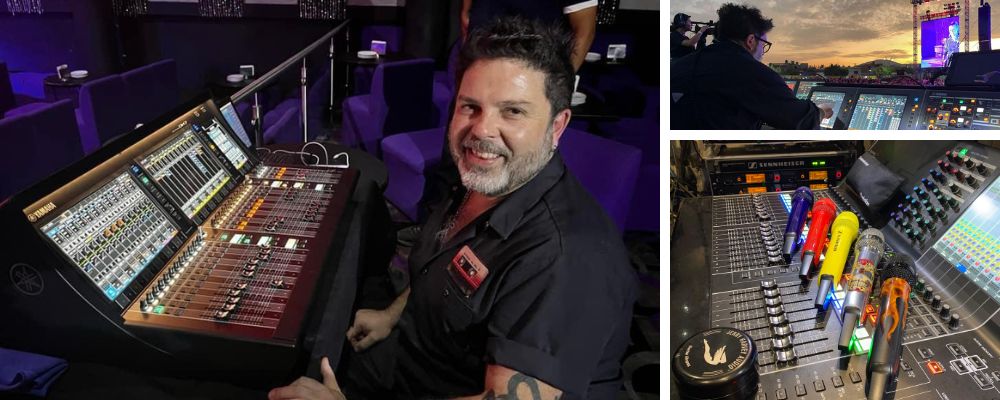
Héctor Álvarez del Castillo, known as “El Chango”—a high school nickname that became his signature—was born in Mexico City and has been passionately exploring the world of audio for over 30 years, guided by a strong cultural heritage and a deep calling for sound.
“My mother was always passionate about protest music, with influences from María Dolores Pradera to Chabuca Granda, including Los Chalchaleros and South American music,” recalls El Chango, who grew up in a house where guitars, Peruvian drums, and bass drums were never short of: “a whole musical arsenal.”
His grandfather, a Tamaulipas music lover and surgeon by profession, nurtured the tradition with an impressive record collection that they listened to together as a daily ritual. And although his aunts danced at Las Palomas de San Jerónimo—a regional dance school organized by the wife of President Luis Echeverría, his grandmother’s cousin—their connection lay not in movement, but in sound: “Dancing wasn’t my thing; my passion was instruments.”
Although his surroundings pushed him toward music, his father—who instilled in him a love of classical music and took him to venues like the Nezahualcóyotl—had other plans for him. But destiny was already sealed: “From the age of three, stuck in concert halls, with the ritual of listening to full albums with my grandfather while we drank coffee, that’s what I absorbed, just like that.”
The obsession with sound became a tradition.
Although there were no formal audio courses in his time, El Chango didn’t stay still. He learned between consoles and empty notebooks, but above all, by observing. “I’m both,” he says when asked if he was self-taught or trained. “Yes, I had formal studies, but in my time there wasn’t anything really formal… I just took courses.”
The real school was a theater, and his mentor, a Spaniard who shaped his path. “I met this man who had come from Spain, Paco Arquero… we clicked immediately with him. He took me under his wing, told me to take a notebook and start writing… of course, the notebook stayed there, and all I did was watch.”
That summer, during a full season at the Teatro de los Insurgentes, he witnessed from the shadows how a show is constructed. “It was a Daniela Romo show called De Mil Colores. That’s where I saw what Paco was doing, and that’s when I said: this is what I want to do.”
Although, of course, that “this” still coexisted with a brighter dream. “I really wanted to be a singer and a rock star,” he confesses with an inevitable smile.
The first leap into the void is called Botellita de Jerez.
There wasn’t a precise point when El Chango said “now I’m a professional,” because from the beginning, every step felt important. But there was a first time when he stood alone in front of a console and took charge of everything. “The first thing I did on my own, the first time I dared to do it myself, was with Botellita de Jerez… it was a Mexican national rock group. Very funny, because it was rock and roll with comedy, but also with protest.”
He was barely 20 years old and was at a festival, with little idea of what he was about to do. But he got on board. Literally. “I got on board without really knowing what I was getting into.” The group’s guitarist, a friend of his since high school, was the one who recommended him. “I had told them I knew audio, and so we went and took the plunge, both of us.”
As is often the case in the beginning, talent is important… but what counts most is enthusiasm. “Yes, yes… ‘This guy knows and doesn’t get paid,’ that was the point,” he laughs. And the punchline falls naturally, with the complicity of memory.
Reaching the big leagues
Although much of the public knew him for his work with Camila, behind the scenes there is a long, diverse path full of decisions that shaped his profile. Today, his professional present combines established artists, such as Edith Márquez and Fey, with independent projects that feed his more spiritual and emotional side.
“I work with Edith, with Fey, with Aterciopelados when they come to Mexico, with Rock en tu idioma… And then there are the independent projects, which are the ones that fill my heart. It’s what I do for love,” he says.
That balance between the mainstream and the intimate seems to have been a constant in his career. After ten years with Camila, he also toured with Alejandra Guzmán, Gloria Trevi, and the famous Versus tour, where the leap in scale was dramatic.
“Versus was a turning point. I was doing arena shows, and they brought me all the equipment exactly as I requested. The console I wanted, the microphones, the in-ear headphones… the letter to Santa Claus was complete!”
“That’s when I said: I’m in the big leagues.”
Until the pandemic, his main role was as a monitor engineer, but something changed: “I was bored of mixing for others. I wanted to do front-of-house, and it worked out for me. Now, with Edith and Fey, I do everything: front-of-house and monitors.”
Far from weighing him down, the multitasking motivates him, especially when it comes to experiences that transcend the technical.
This is how Inmersia was born, a cacao ceremony (an ancestral ritual rooted in the ancient cultures of Central America) with immersive 5.1 audio that he designed with his friend Luis Cardoso during the pandemic. “It was what saved my life,” he confesses. “I designed a system for something completely different: acoustic, intimate, very detailed. I couldn’t have done it without all the background I already had.”
These kinds of projects reconnect him with what’s essential, like his work with René Mooi, a Mexican singer whose voice he describes as “medicine,” or with Kafi, another artist who—he says—”turns his head.”
Looking back, an unexpected reflection emerges: “After Camila, all the artists I worked with were women. I don’t know why, maybe I have a better synergy with them.” Among them, he highlights Fey, with whom he maintains a “super nice, friendly” relationship.
Technique and Heart
Between packed stadiums and intimate ceremonies, large consoles and delicate acoustics, his journey demonstrates that technique can coexist with sensitivity, and that audio can also be a vehicle for something deeper.
“I’m searching all the time,” he says, as if he doesn’t stop even when looking back. Before he touches a single button, he already knows what the person on the other side of the stage needs.
“My greatest strength is being a musician and understanding what musicians are asking for,” he states bluntly. Having been on stage gave him an inner compass that’s difficult to explain and even harder to replicate. And that sensitivity is complemented by a voracious passion that never stops. “I’m always looking for new music,” he asserts.
There was a time when consoles were analog, speakers were connected with “cable lines,” and the setup It was more than artisanal, almost epic. But the technological leap in the last two decades has been as resounding as it has been liberating.
“I don’t have anything to do anymore… I just have to go turn up the faders,” he jokes. Although he knows there’s something deeper behind it: hearing, intuition, sensitivity. “What technology has given me now is that I can think bigger,” he says, and that’s the key.
The future, for him, is marked by immersive experiences. “The Sphere in Las Vegas blew my mind,” he confesses without a filter. He visited it, experienced it, and something clicked. “It makes you think about other things, other possibilities.”
He doesn’t just talk about shows, but about well-being, connection, mental and emotional states. “I think this is where things are going,” he concludes.
Crossing paths with SENNHEISER
The story with Sennheiser didn’t begin as a formal alliance or with a brand strategy behind it. It began the way things worthwhile begin: out of trust, out of admiration. technique and a real need. “It must have been about ten years ago… or more. “I’m terrible at dates,” he admits with a laugh.
But the starting point is clear.
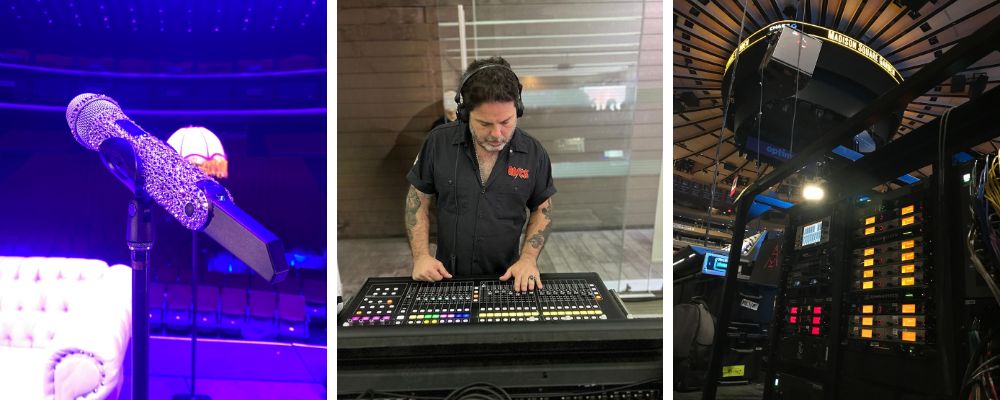
It all began with a conversation between colleagues. Daniel Martínez, one of his best friends and current front-of-house engineer for Mon Laferte, was the one who paved the way: he was working with Natalia Lafourcade and chose a Sennheiser 2000 Series system for her.
“When I joined Alejandra Guzmán’s team, the first thing she asked me was: ‘How do I sound good always, everywhere?’” The answer was straightforward: “You have to have the heart of the show in your hands.”
And that heart was clear: microphones and in-ears. Having control of these critical elements meant eliminating the most common problems in live shows: interference, monitoring errors, microphones mistreated by the rental company.
He approached Julio Bracho, Sales Director for Latin America, and Armando Gonzalez Cervantes, Pro Sales Manager in Mexico, representatives of the brand. And the opportunity didn’t take long to arrive and presented itself: a proposal to acquire the Digital 9000 system, along with the 2000 and 2050, as well as all the wired microphones for drums and guitars.
Alejandra didn’t hesitate. “She gave me a check immediately,” she says, still surprised. Not because of the financial gesture, but because of what it meant: being able to access the best. “It was a sale I didn’t even expect… but I was excited to have everything top of the line. It was never about commission: it was about passion.”
That passion translates into an unwavering conviction. “I do hear a difference in German microphones. I do notice the quality. When I use Sennheiser, I notice it at shows. It’s something else.” Beyond sound, there’s another equally important factor: trust. “With the Sennheiser RF I feel very comfortable. It’s super stable. And when the 9000 arrived… it blew my mind. The scanning was amazing, the sound was like I had a wired microphone. It was incredible.”
When asked which Sennheiser products he uses most often, his answer is clear and straightforward: “I use them all,” he affirms.
“With Edith, I bring a 6000,” he says, and doesn’t hold back. “I have their 20-50s, I mic the entire mariachi with EWX, with some 908s. Wired microphones for all the drums, 600 series. 900 Series on guitars, and the classic 421.” The list goes on: “The last two national concerts with Edith, I brought Neumann MCMs for a string quintet. I use everything.”
Not only on stage, but also in the studio, he trusts the brand: “Here in my studio, I have some KH80s with a subwoofer. I’m a fan, a fanatic.” But what stands out, and what makes it different from a simple business relationship, is the organic nature of the bond: “This wasn’t a ‘we’re offering you this’ or ‘we’re going to give you this much’ agreement. No. On the contrary, I promote them because it’s what I like to use.”
The conversation becomes even more personal when the question about favorite cartridges arises. “I have that one, the 935 too, yes. I love any of those. Obviously, I also love the Neumann. It requires powerful singers, because otherwise, it becomes an ambient microphone when the people aren’t singing loudly.”
In his studio, El Chango works with a system he knows down to the last detail: KH-80 monitors, a subwoofer—possibly a KH-150—and MCM microphones, which also accompany him live. The MCMs were key in a special project: a song written by his friend Daniela de la Torre after overcoming breast cancer. “I wanted to help her,” he says. He recorded guitars with César Huesca using a nylon string inherited from his grandfather and violins with Luis Cardoso, all with MCMs. For the vocals, he chose a TLM-102 in an intimate and meticulous recording, where every acoustic element was carefully considered. He even used the M1, included with his KH-80s, to calibrate the room: “Thanks to its DSP, it equalized everything according to the space.” The result speaks volumes: “I’ve already been fortunate enough to be released by an English record label. Last week I mixed an electronic album and it was incredible.”
And in the end, it all adds up: “And here, it’s all Neumann and Sennheiser, honestly. These speakers sound to me like they do when I get a live setup properly aligned.”
Making a Difference in Sound
If there’s one experience that marked a before and after in his relationship with Sennheiser, it was his time working for Alejandra Guzmán’s team.
“When I joined, I brought what the audio company rented me. But when he bought the 9000 system and I was able to have all that… right off the bat, being able to scan frequencies and create an RF signal from a single device for all the wireless microphones and in-ears made a huge difference.”
But the real breakthrough came with the sound: “The first time I heard his voice through a 9000 microphone—that’s a 6000, which is the same thing—it completely changed my perspective on how things should sound.”
But do the artists notice the difference?
“Fortunately, I’m always one of those who goes into the dressing room and tries to have those conversations with them. Because to be a monitor artist, which is what I’ve done for most of my life, you have to have open communication with the artists. Otherwise, even if they signal to you, you won’t understand. One doesn’t read thoughts, unfortunately, yet… that’s what we’re still working on, developing telepathy.”
With a sense of humor and absolute clarity about the importance of interpersonal connection on stage, he made it clear that technology doesn’t replace the human bond, but it can elevate it to its highest expression.
The Sound of the Future
At 50 years old and with a consolidated career, there are no signs of slowing down. Quite the opposite: what’s coming is expansion.
But that quest is no longer just about adding teams. It’s also an inward journey. “Now I have to invent myself to become my own boss. Keep investing, keep creating new experiences. Reinvent myself. Maybe not just operating audio, but leading something bigger.”
And while that reinvention is still taking shape, there’s a clear destiny: to share.
“All this that was given to me for free through Paco, through Francisco Arquero, I now have to broadcast. I feel it as an obligation. It’s part of my legacy. I don’t have children, but I do have the opportunity to pass on my knowledge to young people.”
Teaching? It’s definitely a possibility. “I’ve given a few masterclasses and I really enjoy it. But I also realize it’s difficult. I remember following Paco wherever he told me to go, and I went. He led me around like the karate kid. I built racks for him, did carpentry. He wanted me to tell him his stories with Luis Miguel, with Camilo Sesto, with Daniela Romo. That was my food.”
Chango wants to give a few words about what he enjoys most. of his work, but the response overflows. “I enjoy finding new music, connecting, joining projects that fill my heart, that make me better. Meeting people who dare to do different things. Visiting new places. Finding magic everywhere.”
In his universe, music isn’t just work. It’s language. It’s purpose. It’s mysticism.
“It’s an unspoken language that can evoke any feeling, that takes you to places in your soul you don’t know. It’s how God communicates with us,” he states with emotion.
He defines himself as an artist. But also as a transducer. “I’m fortunate to be the wizard of frequencies. To be able to express my art and my talent through a console and microphones. When you’re a technician, you study. But when you have it innate, what you do is look for how to communicate better. You’re the bridge between the artist and the people. And that’s a great responsibility: to make sure the message reaches whoever needs to hear it.”
When asked for advice for those just starting out, he doesn’t hesitate: “The first thing is to listen to music. To become music lovers. That opens your mind.”
Then comes the technique, of course. Technology, ear training, practice. For Chango, it’s a matter of patience, of being persistent, of being there. And above all, of humility. “Because there will always be someone who knows more than you,” he emphasizes.
And respect, he insists, is the foundation of everything. “If you treat the people you work with well, if you show them your respect, they will always help you. This profession is about synergy: the technicians, the engineers, the musicians… no one does this alone. And when there’s a solid team that gets along well, it shows. It shows on stage. It’s an incredible show.”
He concludes with a clear and vibrant conviction: “As in sound, where every note you play resonates and returns, everything born of love and humility always finds an echo. Love attracts love, and what you give returns amplified.”
Undoubtedly, a life in sound.


