
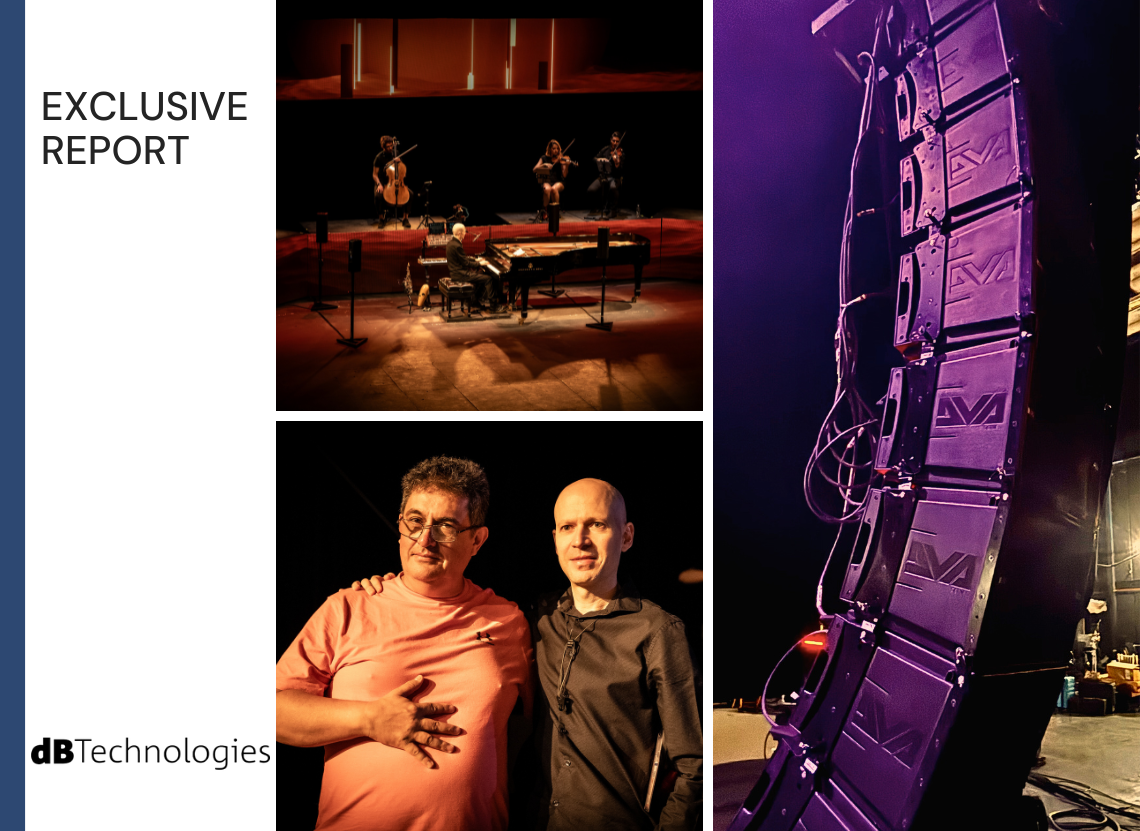
The Esperanza Iris Theater was the stage for a challenging technical and artistic proposal, in which the quadraphonic format and meticulous sound design combined to transform the listening experience into a complete experience.
On April 5th, Mexico City’s historic Teatro de la Ciudad Esperanza Iris, a World Heritage Site since 1987, was transformed into an epicenter of sonic innovation to celebrate Piano Day. Under the artistic direction of maestro Daniel Aspuru, the proposal was as ambitious as it was precise: to offer a quadraphonic concert capable of enveloping attendees in a totally immersive experience.
To achieve this, Aspuru enlisted the experience and vision of sound engineer Gonzalo “Chacho” Peniche, an absolute leader in multi-channel system design and one of the pioneers in the adoption of surround sound formats in Mexico and Latin America.
A pioneer of sound immersion
With more than 30 years of experience in the professional audio industry, Chacho Peniche has worked in a variety of settings that few can boast: from heavy metal concerts with international bands to theater, symphonic music, and advertising productions. His career began in 1985 as a stage technician, and by 1988 he was already mixing live bands. A turning point came as the staff engineer for the Basque band Ángeles del Infierno, at which point he decided that sound would be his life’s work.
His interest in multichannel audio dates back to his childhood: “I’ve been listening to multichannel since 1974; my father had a quadraphonic system at home. I was always obsessed with going beyond two speakers,” he recalls. This interest led him to be one of the first in Mexico to mount 5.1 productions, such as the musical Cabaret in 2005 and the recording, mixing, and mastering of Moenia Hits Live in DTS 5.1.
In addition to his work on live shows, he currently collaborates with Allen & Heath on the Live Room in Mexico City, a digital console demonstration and training center for audio professionals. He has also been responsible for sound on large-scale theatrical productions such as 7 veces adiós, and is an active knowledge disseminator through social media and specialized interviews.
The Challenge of Esperanza Iris
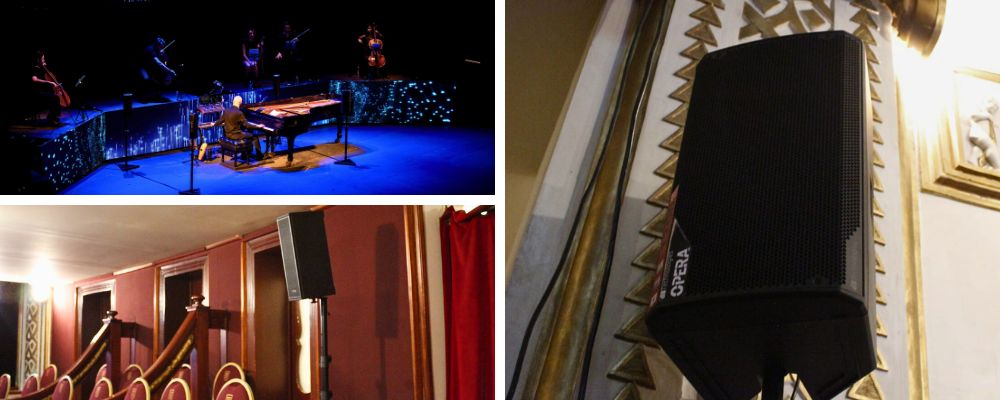
The Piano Day concert was not a conventional setup: the quadraphonic format had to work consistently across all four levels of the venue, including the ground floor, first, second, and third floors, maintaining precision and naturalness throughout the space. “Each floor presented different configurations and challenges to ensure the entire audience could experience the quadraphonic sound,” Peniche notes.
The technical team included support from Ampere Manufacturas, dBTechnologies‘ distributor in Mexico, and Jorge Araiza Perez, Applications Engineer at dBTechnologies for Latin America, whose technology was key to achieving the result. “We chose dBTechnologies because before this event, we had completed a project called La Gira de los Faros (The Lighthouse Tour) in cultural centers in Mexico City. There, we tested the ES-1203 system and saw that it allowed us to split it and achieve a quadraphonic system with an excellent cost-benefit ratio. In the theater, the products performed perfectly: they did exactly what they were supposed to do in coverage and adapted to each space.”
On stage, Aspuru used quadraphonic monitoring using two ES-1203 systems in stereo mode. The main system consisted of a DVA T12 as main L-R, with eight speakers per side, a VIO X206 as infill, an S30N as subwoofers, and various models from the OPERA and MINIBOX series to reinforce each level of the theater.
Over the past two decades, loudspeaker technology has made giant strides. Today, it is possible to achieve extremely controlled and predictable dispersion, with more homogeneous and consistent sound coverage. Projections reach greater distances, while the size of the cabinets has been significantly reduced.
In this context, compact models like the dBTechnologies VIO X206 represent the culmination of years of advances in design and performance. This dBTechnologies product, part of the VIO family, offers a powerful, high-definition sound experience with excellent clarity and uniform coverage, especially for small to medium-sized sound reinforcement applications. Its compact design, yet with considerable sound pressure, allows for versatility in both live sound and installation applications. Furthermore, its ability to be configured as a line array expands its possibilities for more specific requirements.
Creativity and technology at the service of immersion
Pre-production was just as decisive as editing. What began as a stereo concert evolved to quadraphonic sound, exploring the potential of di distribute instruments, effects, and atmospheres across four locations. “The Prophet, native to quadraphonic, was central. Daniel generated a layer of sounds, and I played in real time from the console, animating sound objects and combining two stereos, one front and one rear, depending on what we wanted to convey,” he explains.
Regarding monitoring, he highlights the aesthetic and functional advantages of the ES-1203: “Its ultra-small size and slim design were visually perfect, and the sound was the same as the one Daniel rehearses with, so everything felt familiar.”
The dBTechnologies ES1203 stands out as a tri-amplified stereo sound system, with a total power of 2400W, and is characterized by its clarity, precision, and ability to adapt to different environments. Its specially designed dBTechnologies logarithmic curved column technology helps maintain consistent horizontal coverage and excellent intelligibility in the listening area.

Vision of the Future
Peniche is clear when speaking about the immersive scene: “It’s a clear trend, but form is often confused with substance. People are more enthusiastic about moving the sound object than about the content itself. You have to have references: immersive music has centuries of history, from Monteverdi and Mahler to Pink Floyd, Kraftwerk, and Björk.”
Looking to the future, he hopes that dBTechnologies will continue to innovate and support independent projects: “The relationship with their team and their distributor in Mexico is extraordinary: very committed professionals. And I can say that I’ve known Eduardo Quintero for almost 20 years; he’s a great professional and a great friend.”
The Piano Day experience at the Esperanza Iris left a lesson: with the right talent and the right technology, it’s possible to bring an immersive concert to any space, no matter how challenging. Chacho Peniche knows this better than anyone, and his work with dBTechnologies confirms it: when passion and innovation converge, the result is a sound experience that transcends convention.


